
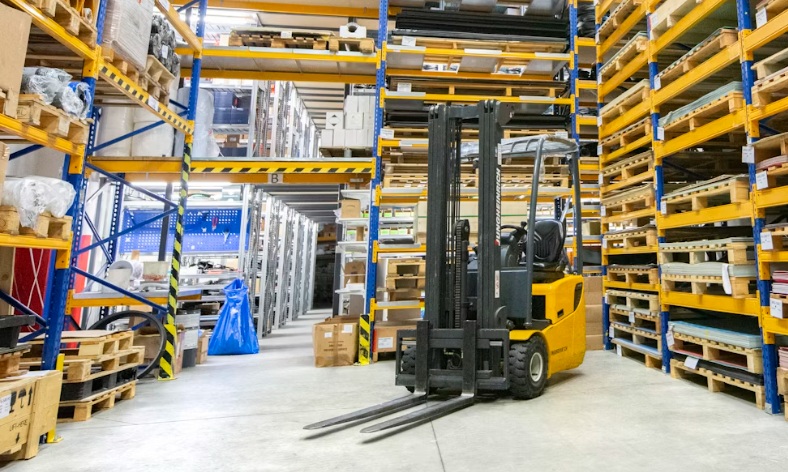
Forklift operators go through consumer tablets faster than almost any other warehouse role. A device that works fine on a desk cracks, freezes, or dies within weeks of being mounted to a lift truck — and the replacements fail the same way. The cause usually isn’t operator carelessness. Consumer tablets were never engineered for the specific forces a forklift subjects them to.
This guide breaks down the four things that actually destroy tablets on forklifts, why consumer devices can’t withstand them, and how to tell when a rugged industrial tablet is the right call versus an over-purchase.
The four causes of forklift tablet damage
1. Constant vibration
This is the number-one killer, and it’s the least obvious. A forklift transmits continuous low-frequency vibration through the mast and frame into anything bolted to it. Consumer tablets have solder joints, ribbon connectors, and camera modules that are fine under occasional handling but fatigue and crack under sustained vibration. Failures show up as intermittent touchscreens, ports that stop charging, and devices that randomly reboot—symptoms that look like software bugs but are physical.
Rugged industrial tablets are validated against MIL-STD-810H vibration testing specifically because vibration fatigue is the failure mode that consumer testing ignores entirely.
2. Shock from drops and impacts
Forklift work means curbs, potholes, sudden stops, and the tablet occasionally being knocked or dropped onto concrete. A consumer tablet’s glass and internal components are designed to survive a drop or two from waist height onto carpet — not repeated impacts onto a hard floor. Even a case that stops the screen from shattering doesn’t stop the internal shock from loosening connectors over time.
A rugged device with a stated drop rating (typically 4–6 ft onto concrete) absorbs and distributes that impact through a reinforced chassis rather than passing it into the electronics.
3. Poor mounting
A surprising share of “tablet damage” is really mounting failure. A consumer tablet strapped into a generic cradle or clamp puts stress on the device edges, blocks ports, and leaves it free to rattle — which feeds problem #1. Worse, most improvised mounts rely on the tablet’s charging cable, which loosens from vibration and either stops charging mid-shift or gets yanked and damages the port.
The fix is a purpose-built powered dock that secures the device on all sides, dampens vibration, and delivers power through the mount (pogo pins) rather than a loose cable. Mounting is where the cheapest interventions often prevent the most damage.
4. Warehouse environmental conditions
Dust, temperature swings, moisture, and cold-storage condensation all attack consumer tablets that have no sealing. Dust works into unsealed ports and speakers; moving between a freezer and an ambient dock causes condensation inside the device; and consumer tablets throttle or shut down outside a narrow temperature band. None of this is drop-or-shock damage, but it produces the same result: a dead device.
Rugged tablets carry an ingress protection (IP) rating — IP65 or higher — and a wide operating temperature range precisely to survive these conditions.
Why consumer tablets can’t be “cased” into surviving
The common assumption is that a rugged case turns a consumer tablet into an industrial one. It doesn’t. A case addresses exactly one of the four causes — impact — and only partially. It does nothing for vibration fatigue on internal components, nothing for ingress protection on an unsealed device, and nothing for temperature range. Buyers who go the case route typically see the same failures a few weeks later and conclude “tablets just don’t last on forklifts,” when the real issue is that the underlying device was never built for the environment.
When a rugged industrial tablet is the right fit — and when it isn’t
Rugged isn’t automatically the answer for every device in a warehouse. Here’s the honest line:
A rugged industrial tablet is worth it when:
- The device is mounted to a forklift or other vehicle (vibration is unavoidable)
- It operates in cold storage or areas with dust, moisture, or temperature swings
- It runs across multiple shifts or continuously
- Downtime from a failed device costs more than the price premium — which, in high-throughput operations, is almost always the case
A consumer tablet may be fine when:
- The device stays at a fixed desk or kiosk in a climate-controlled office area
- It’s handled occasionally rather than mounted and used all shift
- Replacement is cheap, and downtime is inconsequential
The dividing line is mounting and environment, not budget. A tablet that lives on a forklift will fail as a consumer device — the only question is how many replacement cycles it takes to reach that conclusion.
Total cost of ownership: the real math
The reason rugged wins for forklift use isn’t durability for its own sake — it’s cost over time. A consumer tablet at a lower sticker price that fails every few weeks costs more across a year in replacements, IT time, and downtime than a single rugged device rated for the environment. In a busy operation, one hour of a stalled forklift often exceeds the entire price difference between the two devices. Glacier offers Getac’s dockable F120, which is built for this profile: IP66 rating, MIL-STD-810H, MIL-STD-461G, and up to a 7.74V, 4070mAh hot-swappable battery for multi-shift use.
Frequently asked questions
What causes forklift operators to damage consumer tablets so often? The main cause is constant low-frequency vibration from the forklift, which fatigues and cracks the internal connectors and solder joints in consumer tablets over time. Shock from drops and hard stops, poor mounting that leaves the device free to rattle, and warehouse conditions like dust and cold add to it. The damage is usually physical and cumulative, not the result of operator misuse.
Can a rugged case make a consumer tablet last on a forklift? Not reliably. A case only addresses impact, and only partially. It does nothing for vibration fatigue on internal components, ingress protection against dust and moisture, or operating temperature range — which are three of the four causes of failure. Consumer tablets in cases typically fail the same way a few weeks later.
What tablet specs matter most for forklift mounting? Look for MIL-STD-810H vibration testing, a drop rating of 4–6 ft onto concrete, an IP rating of IP65 or higher, and a wide operating temperature range if you run cold storage. Just as important is a purpose-built powered dock that dampens vibration and delivers power through the mount rather than a loose cable.
Is a rugged tablet always worth the higher cost? For forklift and vehicle-mounted use, almost always — the total cost of ownership is lower once you count replacement cycles, IT time, and downtime. For a device that stays at a fixed desk in a climate-controlled area and is handled only occasionally, a consumer tablet can be fine. The dividing line is mounting and environment, not budget.
Stop replacing forklift tablets
If you’re going through consumer tablets on your lift trucks, we can spec a rugged configuration matched to your mounting, environment, and shift pattern — and show you the total-cost math against what you’re spending on replacements today.
Request a forklift tablet fit assessment →